Showing posts with label Dunrobin. Show all posts

Saturday, 20 January 2024

Duke of Sutherland's 4-wheel saloon in 7mm scale.

Duke of Sutherland's small 4-wheel saloon.


The duke of Sutherland's small saloon was built in 1908 by the Highland Railway at their Lochgorm works. After many travels and tribulations the coach, along with duke's locomotive Dunrobin, were repatriated from exile in Canada to Beamish in 2011. This event coincided with the production of a model of the coach by Lochgorm Kits in both 4mm and 7mm scales. The coach, beautifully restored to original condition, though with modified seating, is in service at the open air museum, the loco is still under restoration.  


Detail of the step end of the coach with glazing in place, castings are all brass and from various sources. 


The kit is not designed with an interior other than a lavatory enclosure in mind. The coach, as I've modelled it, is not intended to be viewed without the roof, the simplified interior gives an impression when seen through the glazing that the interior is fitted out. In earlier days there were armchairs and a table in the saloon end.


The service end had built-in seating and the corner units hide the bolt heads that secure the chassis to the superstructure. The interior is simplified, the lavatory compartment in reality is a particularly fine Victorian survival, modelling this would have been a minor work of art in itself.


The coach was built in three modules, a departure from the design of the kit, these were the roof, the body and the underframe or chassis. The coach body has had a floor added and is fixed to the underframe with four hidden screws, the roof is a neat friction fit into the body. Above you can see some of the hidden detail beneath the coach. The cast brass springs and their "J" hangers were particularly challenging to construct, the hard castings proving particularly resistant to efforts to drill through them. The ride height of the coach was increased by 2mm to allow space for the springs and axleboxes. The rocking-axle compensation system works well and the coach glides smoothly, though I question whether the bother involved in making this is worth the effort.
...

58A in 7mm scale painted by Paul Moore


The etched lavatory window was quite a challenge which took three of us to make. I thought the solution was a photo of the real thing, so I asked Paul Jarman at Beamish to take some photos for me. He took some photos in the shed where 58A is housed for the winter though the cramped situation of the coach made it difficult and the pictures needed some work on Photoshop which my daughter Alice, who knows about these things, managed in no time at all and printed them to size for the model. Paul Moore did the rest, mounting the print behind acetate to achieve what I think you'll agree is a most realistic result. The colour scheme of the coach matches that of my model of the duke's engine Dunrobin, which is in a private collection where 58A will shortly join it.


The duke's coach from the other side.


Monday, 11 January 2021

Dunrobin, a joint effort, Painted.


Some notes on the livery of Dunrobin 1895 to 1965

Dunrobin’s livery can be generalised as described in Cormack and Stevenson's, Highland Railway Locomotives Book 2 “…dark green with black lining double-edged in gold.” This livery was carried throughout the engine’s varied career.


Photo Paul Moore


I received the accompanying photos of Dunrobin from Paul Moore this week, he painted and lined the model and has done a great job on it. It was intended to depict the engine in its earliest livery in the service of the duke of Sutherland, so reference was made to the photograph of Dunrobin of 1895 which shows the engine newly built at the Atlas Works of Sharp Stewart in Glasgow. The engine is shown in works grey and displays an elaborate though elegantly designed livery with double-edged lining in panels with a black border. The angle of the photo does not allow detail to be seen of the buffer beam, nor the tank front, cab front or the rear of the bunker. 

A photo from the Highland News of 17 Sept.1921 shows Dunrobin under the station canopy at Inverness decorated with a leek in front of the chimney, awaiting the arrival of the Prince of Wales. Closer inspection of the photo reveals a rather different livery to that shown in earlier photos, Dunrobin appears to have been recently refurbished in response to the royal visit. The black border to the lining on the tank and cab sides has gone, though it is retained on the front splasher. The lining panels, though still the same black double-edged gold as before, have been widened on the tank sides and double edged-lining can also be seen on the cab front and tank front. Evidence does not confirm that there was a panel of lining on the tank front earlier than this photo. An earlier photo does however show that there was no panel of lining on the cab front before 1921 and this is reflected by the model. It is probable, though the photo is not clear enough to confirm this, that the lining on the tank sides was changed at this time from a simple rectangle to a shape that enclosed the side window. 

The 1921 photo provides the first evidence of how the buffer beam was lined and panelled, it is thought that the buffer beam remained essentially unchanged throughout Dunrobin’s chequered history... green with a red central panel lined black. The buffer shanks may have been green originally too, or possibly red, there is no conclusive evidence. I like them green, so green it is for the model.


Dunrobin at Inverness 1921

It is intended to put the preserved Dunrobin into service in as near as possible original condition and carrying the pre-1921 livery, based on the works grey photo. After much deliberation Paul Jarman and his team at Beamish have decided that the full size engine will look the part in classy Landrover Bronze Green. Dunrobin’s original dark green was not Highland Railway green, nor was it the blue-green in which she was repatriated from Canada in 2011. Though the lining is described as “black, double-edged gold” this is not thought to refer to a metallic gold, but rather to a colour somewhere between straw and yellow. 

Paul Moore mixed the basic green for the model Dunrobin, it is not Landrover Green, it is his interpretation of the colour of the engine and the black double edged straw/gold lining was agreed between ourselves as being the most likely as well as the best looking lining to enliven the overall green. The brass incised nameplate was commissioned from Narrow Planet.


Dunrobin 1899 in works grey. Photo courtesy of the HRSoc


Photo Paul Moore

Photo Paul Moore

In 1946, after war service with the Royal Navy, Dunrobin was overhauled and repainted with the lining following the previous scheme of 1921. 

In 1949, the duke sold Dunrobin to Capt. Howey of the Romney, Hyth and Dimchurch Railway and in 1950 the engine travelled to New Romney partly under her own steam. Publicity surrounding the event led to a renewal of interest and a large number of photos which record the engine showing the livery unchanged during this period.

Initial interest waned and by 1965 Dunrobin was in the doldrums, she was sold to Harold Foster of British Columbia and shipped to Canada. Many changes were made during her 46 years of exile, which have fortunately now been removed at Beamish Museum, her new home. 


 If you look carefully you can see that this photo of 1902 shows Dunrobin in the livery of the works grey photo of 1895


Tuesday, 10 March 2020

Dunrobin, construction complete.

Construction of Dunrobin is complete, note that all the fittings are cast brass. The brass nameplate displays the name in incised letters, it was etched by Narrow Planet.


Construction of Dunrobin is now complete, here are a few photos of the engine. Painting and lining will I hope be undertaken by Paul Moore, though I'll probably paint the cab interior and its details myself. The crew will be from Invertrain's Heroes of the Footplate range, which I sculpted myself, and I might paint a figure or two to go in the cab seats too.


Much buffer beam detail was added, brass rivets, safety chain suspension rings and horse hooks.  
Tank top inspection panels were added from photos from Beamish. Note the quality brass fittings.


Below the footplate is a busy place, the sandbox and the iron picnic box above the rear bogie wheel are brass castings.


I have added all the detail to the cab interior that I have evidence for, though I have omitted all the Canadian fittings which have also been removed from the real engine.


There is seating for four passengers above the coal bunker.


Dunrobin is due to be in service at Beamish in 2021, however I hope that my model will be painted and lined and in service herself before then.

Monday, 24 February 2020

Dunrobin...More progress

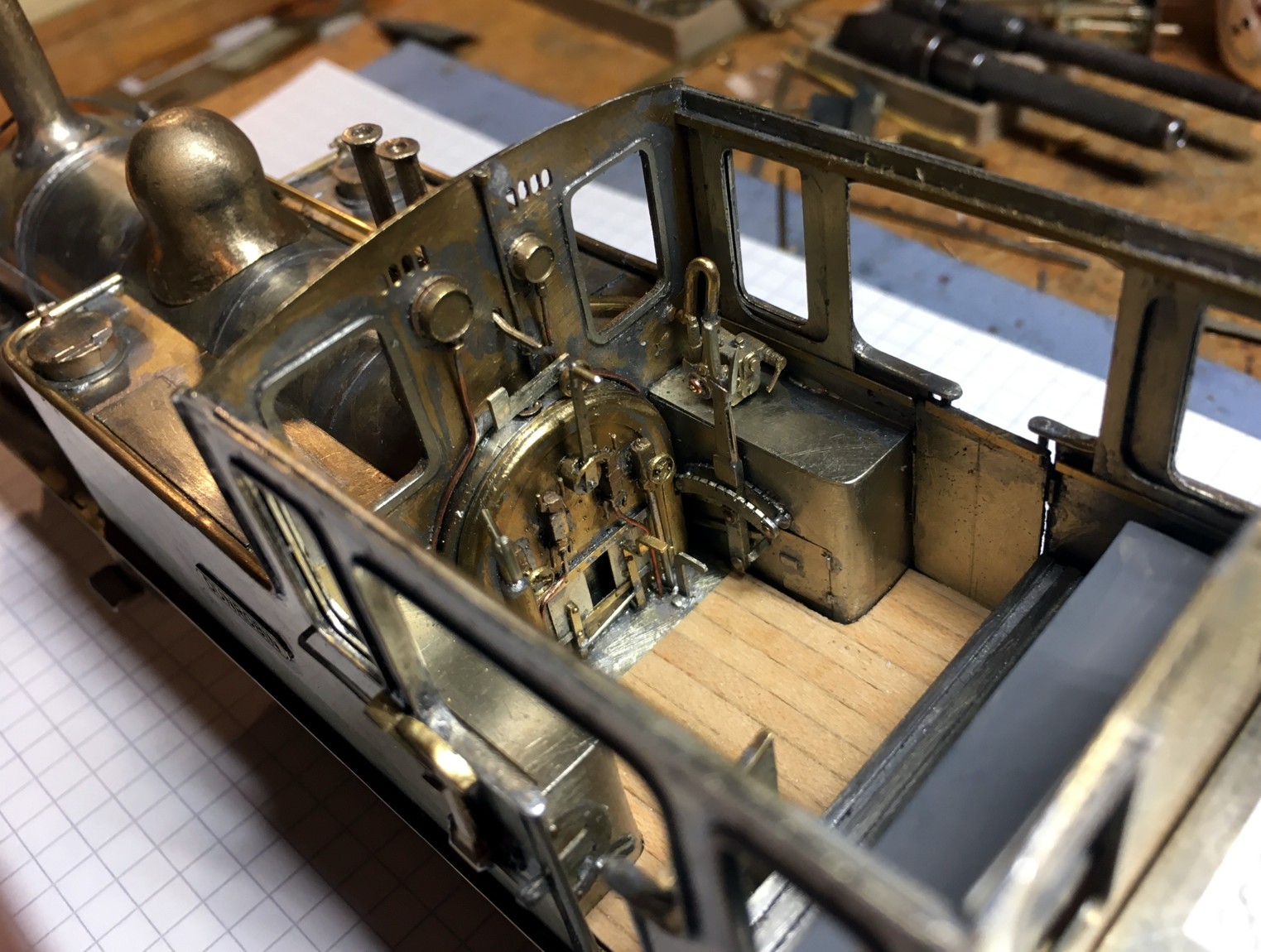
Boiler backhead in place with modified fire hole door
I had help from Paul Jarman at Beamish museum who supplied some photos of Dunrobin which clarified most of the details of the cab interior. I'm still not sure about my positioning of the Dreadnought vacuum ejector, which you can see sitting on the right hand inner tank top, behind the reversing lever. The original ejector was removed in Canada when Westinghouse braking equipment was fitted; it languished on a shelf in a workshop there, where fortunately it remained until its repatriation along with the engine in 2011. Apart from the ejector, which is provisionally positioned at the moment, the inner tank tops are at this stage still bare of equipment, though I'm sure that evidence will emerge of detail which can be added to enliven this area. The cast brass backhead supplied in the kit has been modified so the firehole is now correct with horizontal sliding doors and operating lever at floor level.

Photos from Beamish and a GA drawing of the cab area from Sharp Stewart the builder, provided the details for the seating in the cab rear. There are duckboards for the passengers' feet and a padded seat, which are above the coal space, the coal door is central at floor level. On the rear wall of the cab, above the windows, can be seen a coat rail; between the windows there should be a set of framed autographs of distinguished passengers, details of which I have yet to clarify.


Cab rear with seating for four people with coal bunker below.


Dreadnought ejector sits on the tank top connected to the ejector pipe which can be seen through the window.

Some of the castings for the boiler backhead are taken from the 4mm scale version of the engine which were rather over scale. Other cab details including the reversing lever and brake standard were constructed by the author. On top of the backhead sits a handwheel, a detail which I hope to enlarge on as my understanding of the cab controls and gauges develops. The wooden floor is constructed from model ship planks and is in two parts, left and right, to allow for removal. The mechanism for operating the tablet catcher is fixed to the end of the left hand inner tank. Note the inner sliding cab windows which are single skinned and will eventually be glazed by simply affixing a sheet of glazing to the rear after painting; the handles for these windows will glue to the glazing.


Tank tops and ejector pipe are well seen in this view.

The original ejector pipe was removed in Canadian days so I have relied on photographs to restore it to its correct position. It kinks towards the boiler after leaving the smokebox and is supported from the boiler just after the bend.  After running along the boiler towards the cab, the evidence of a hole in the cab front plate suggests that the pipe crossed over the tank top towards the outside of the engine to enter the cab and connect with the Dreadnought vacuum ejector inside.
Narrow Planet provided the etched nameplates.
The tapered buffer housings, which have a square base, were modified from a set of Slaters' GWR buffers but are still a couple of scale inches longer than the prototype's miniscule 9 inches.


Brass castings for rear sandboxes and picnic hamper boxes are soldered to frames.

Roof in place emphasises the large space occupied by the cab.

Monday, 20 January 2020

Dunrobin...Progress.

Dunrobin superstructure, parts in nickle silver are replacements or additions by the author

The cab sides needed the top rail above the cab door thickening and the only way I could do this was to replace the whole side. I'm working on the new sides in the flat, adding the inner sliding windows which completely enclose the cab when closed. The separate assemblies of the engine, the boiler and smokebox, the tank and cab sides and the footplate and cab interior, will be assembled when the interior is as complete as I can make it. The stepped seating arrangement in the cab rear is based on photos taken at Beamish, after Dunrobin returned from Canada. I have a couple of pictures of part of the inner cab front plate and the top of the backhead, though I the suspect that some of the equipment in the pictures was added in Canada and is not relevant to a model of the engine in original condition.


Part of the frame will be removed behind the front bogie wheel to allow the bogie free movement

Cab interior showing inner sliding windows and right hand drive reverser.

The cab of Dunrobin is generously proportioned because of the seating at the back of the cab and I plan to fully detail the interior though I have not yet obtained all the information I need to complete the backhead and other details at the front of the cab. I have a useful side elevation drawing of the cab, which shows the reverser well and allowed me to model the lever and its ratchet frame. On the opposite side of the cab, the fireman's side, stands a handbrake stanchion for which I also have information enough to make one.

An important consideration in building Dunrobin was the manner in which the cab windows were to be glazed to look convincing not only from the outside but from inside too. My solution was to double-skin the cab sides to allow the glazing to slide between the outer and inner skins. The sliding inner windows are a single layer with glazing glued behind them with ZAP canopy glue, which dries clear. These windows slide in 1mm U section brass, soldered inside the cab sides.
I decided not to double-skin the cab front and rear plates due to the presence of those etched ventilation slots high up between the windows, these I could not reproduce on the cab inner with any accuracy, so single skin they remain and I think they are more convincing as they are.

The driver's door on the right hand side is modelled closed because the driver will be positioned there leaning on door and looking out of the cab. The left hand cab door will be in the open position to allow a good view of the cab interior detail, the inner sliding windows will also be open.


ABC Gears triple reduction gearbox with 1625 motor  

Power is supplied by an ABC Gears "PUG" gearbox, designed for small prototypes, the 1625 motor drives the fixed rear axle through a triple-reduction gearbox.  The mechanism sits upright in the firebox and fits inside the diminutive 3ft 9" diameter boiler very neatly. Wire pick-ups bear on the rear of the wheel rims on the left hand side and on the right are shorted by means of an 0.5 wire running in a spoke, which connects the brass central hub to the wheel rim.

Thursday, 26 December 2019

Dunrobin, Making a Start.

Dunrobin frames under construction

Lochgorm Kits' 7mm kit for Dunrobin, the duke of Sutherland's private engine, was I believe designed originally in 4mm scale by Alastair Wright of 5522 Models and enlarged to 7mm by the late Andy Copp when he took over production of the former's Highland Railway kits in 2011. Alastair began introducing Highland Railway designs to his range in the 1980's; these were hand drawn and, though not designed for 7mm, when enlarged they served well enough though they took their faults with them to the larger scale and magnified a number of these, so some of the etched parts of this kit need to be remade with more accurate replacements.

The chassis (above) is etched in sturdy 0.7 nickel silver and the frames are a respectable 26.4 mm outside diameter so I had to file a bit off the frame bushes to free the wheels. I've introduced a few more cross-members for the cylinder front and rear and for the ash pan. I've ordered an ABC Gears' Pug Special gearbox with a Canon 16 x 20 motor which I think should provide enough power for this little engine. It will sit upright in the firebox and drive the rear fixed driving axle.

Rear bogie complete

The bogie builds well without much modification and is a solid job. I used Slaters' 1/8" frame bushes for the axles. I plan to mount wiper pick-up wires behind the left hand wheels and short out the wheels on the other side; I'll try silver conducting paint and see if that works.


The superstructure is built on a flat wooden former. 

The boiler in the kit was half-etched to provide boiler bands, which resulted in a flimsy structure, this inadequacy when compounded with a mistake in the diameter of the boiler condemned the offending part to the recycling bin. The front splashers were found to be undersize and new parts were made to replace these too.

I intend to double-skin the cab all round so the acetate glazing will slide between the outer and inner skins; in addition the inner sliding cab windows will be constructed in this manner too. The cab front and rear present no problem though the cab sides will be replaced with more accurate parts to facilitate my ambitious glazing scheme.

Currently the real Dunrobin is undergoing major reconstruction, so there's nothing of her to see at Beamish, her home, though their newsletter is helpful and charts progress. I intend to build a detailed cab interior, though it's going to be some time before I get to this stage, I hope that by then I'll have more information on this aspect of the engine. At the moment some details, particularly of the backhead and controls, are rather hazy.

Photos taken on an Apple I-Phone 11.