Showing posts with label LNWR. Show all posts

Thursday, 16 November 2017

Precursor Tank details

LNWR Precursor Tank No.44 c.1906

LNWR 44 was built from a Taff Vale/Dragon Models kit with many improvements and additional detail. Ample motive power is provided by an MSC Models motor and gearbox with 3 stage 40:1 helical gears. The completed engine weighs in at just over 1kg with space for more weight if necessary. I intend to test run her with a reasonable load at the Running Day next weekend on the Carlisle club layout. The cab interior is finished now so construction of the engine is complete.
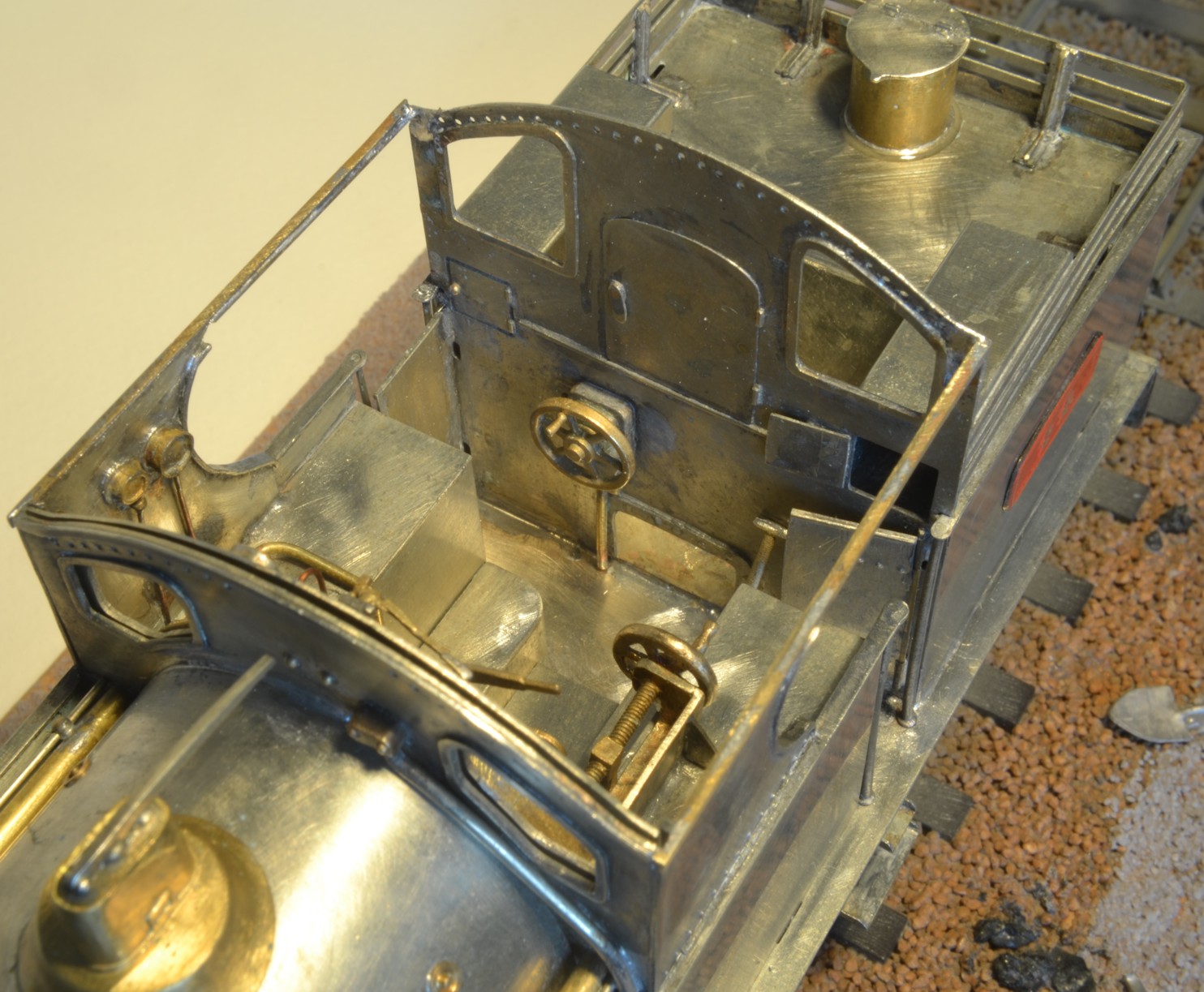

LNWR 44 cab interior detail

I did not have a GA drawing to help with details of the cab interior, I don't think one exists,  so I've done my best with what information I have been able to glean from a variety of sources. I could have added more but restrained myself from filling the cab with dubious or speculative details. The cab rear spectacle plate features a coal hole at footplate level, access doors to the coal space and tool boxes and a brake wheel, note also the opening cab doors. All components are brass or nickle-silver, either sourced from LGM or made by myself, no white metal was used in the construction.


LNWR 44 Cab interior and backhead detail.


The backhead and front spectacle plate are a unit and can be removed for painting; the glazing slides between the inner and outer spectacle plates. The bottoms of the windows are six feet above footplate level so the crew needed some means of levitation to see out of them. The model's interior step arrangement is based on that of the LNWR Bowen-Cooke 4-6-2T which was introduced only four years after George Whale's Precursor Tank and which has a cab of comparable proportion and fortunately for which a GA drawing exists. The GA shows that the coal hole and shovelling plate of the Bowen Cooke engine was well above footplate level, a novel innovation which eased the fireman's task. I suspect that George Whale may have had a similar consideration for his crews, however the designer of the Precursor Tank kit thought otherwise so I 've deferred to his judgement in this case and left the coal hole at footplate level.

Contemporary photos of crew working in these engines confirm the existence of the interior step arrangement which served to elevate them well above footplate level and enabled them to see ahead through the cab windows.

The roof of the model slots into place and can be removed to facilitate painting and later examination of all the interior detail.


Exterior of cab of LNWR 44 with door open and showing some interior detail
 

LNWR 44 smokebox and buffer beam details


The removable lamps have brilliants set into them, clear to the front and red behind. The author's nickle-silver smokebox door replaces the white metal casting supplied in the kit. There are a large number of tiny brass rivets replicating the real thing in the hinges of the "piano front" and larger bolts can be seen on the bottom of the smokebox wrapper, these tiny brass fittings are inserted into holes and soldered in from behind.

Wednesday, 20 September 2017

LNWR Precursor Tank

LNWR Precursor Tank No.44 built 1909.  3' 3" bogie wheels, exterior sand boxes and Bowen-Cook buffers.

Pete's Precursor Tank was built with the aid of a Dragon Models set of etches and the brass castings that come with the kit though without any of the white metal fittings supplied which were replace by components sourced elsewhere or by scratch building, an example of this being the smokebox door. Construction is complete apart from the cab interior which awaits delivery of an LGM brass backhead casting. There has been a good deal of improvement made to the basic kit and additional work has been done using contemporary photographs as reference to ensure that all exterior detail is included in the model. The basic inside motion parts from the kit have been fitted, viewed from the angle of the photo the slide bars are just discernable in the gloom between the frames.

The engine is powered by an M1833 motor mounted in an ABCGears gearbox which is mounted upright on the rear driving axle. Current pick-up is through wires bearing on the treads of the drivers and the rear of the bogie wheels on one side of the engine; on the other side the wheels are shorted by means of a wire inset behind the spokes. Slaters' wheels are used throughout, the axles run in brass bearings which slide in slots in the robust 0.7mm side frames. The upright motor leaves no space in the boiler for a flywheel, however the running qualities of the model were more than acceptable when she ran on the Carlisle club layout last Saturday.

The cab front is double skinned which allows the inner skin to be removed at this stage for detailing. The backhead and all its attendant fittings and pipework will be attached to this inner skin, an arrangement that also facilitates glazing at a later stage. Similarly at this stage the rear bunker assembly can be removed to allow access to the cab though later this will be soldered into place; the roof will be soldered on too as this will add strength to the structure. Nevertheless the large cab side cut-outs, generously proportioned rear windows and hinged opening doors will ensure that the cab interior detail remains much in evidence.

Saturday, 7 March 2015

LNWR Chopper Tank revisited.


LNWR Chopper Tank from an ABS kit with additions and improvements.
 

I had the superstructure of this engine painted by Conrad Cooper of Criccieth who also expertly added the boiler bands and LNWR lining. I asked him not to work on the cab interior as this was a job, along with painting the crew, that I wanted to do myself. This is a time consuming process and relies on hand painting methods rather than air brushing and lining techniques, I thought it more my line than his.


2-4-0T Chopper Tank

I hand painted everything below the footplate myself, paying particular attention to the firebox for which I used colours from photos of other engines then brought it to life with a good deal of dry brush work. I applied matt black to the smokebox wrapper and front then scrubbed this with an old brush to relieve the lifeless effect of dull matt paint. I dry brushed some metallic gunmetal onto edges and rails though when I saw the effect of this in better lighting conditions I thought I'd overdone it, so I'm in the process of removing some of this.


Chopper Tank cab interior

The HMRS publication "LNWR Liveries"suggests using two parts indian red to one part ivory black to reproduce the colour of the cab interior above the splashers. I found that a touch of black was enough to produced an acceptable effect, the HMRS recipe being too dark. Cab detail is from the ABS kit with some additions though I suspect it is not the full story, the pipe on the right hand side of the boiler does not enter the cab; if it did I know it would have given rise to a good deal more pipework. (see the coal tank cab below). Those wooden plinths beside the fire door for the crew to stand on are topped with real planking. The works inside the cab were lightly dry brushed with metallic paint then scrubbed with an old brush to achieve a metallic sheen which I think works well in the cab. The brass pressure gauge on the spectacle plate, which is a white metal casting, was first given a coat of metallic paint well darkened with black, this was then given the slightest of touches of rather brighter brass paint just on top where it catches the light and then varnished...it doesn't look as good as a real brass gauge though, even after all that fiddling about. I'm not convinced that brass, silver and steel paint, even the so called "metallic" paints, however skilfully they're applied are successfull in representing these metals. It's a much better option to obtain a real brass gauge or a brass hand wheel than to attempt to paint a white metal one to look like brass. Note that the window surrounds are real brass!


Crew from the Heroes of the Footplate range.

You can just make out part of the wood block floor that characterised many LNWR engines between the splashers in this picture, The fireman is resting his shovel on its rear edge, beyond the floor is of steel plate. The crew, of about 1900, are from my own Heroes of the Footplate range (Refs: R1 & R2) and are designed specifically for a small tank engine. They are posed to maximise the space available in a cramped cab, the space being additionally restricted by over scale wheels and the resultant narrow gap between the splashers.

Note that painted figures are available from Heroes of the Footplate, prices on request.


LNWR Coal Tank cab interior


Cab of an LNWR Coal Tank c. 1891 based on a drawing in Pete Skellon's recent book on the LNWR Coal Tanks. This is work in progress and more pictures of the engine will feature in future Blog postings.